Wafer Marking Studio
Bringen Sie SEMI-Schriftart, SEMI T7 und BC412 auf der Rückseite von Silizium-Wafern an.
Willkommen bei Barcodesoft
Generieren Sie QR-Codes in MS Excel-Tabellen, MS Access und Crystal Reports.
Willkommen bei Barcodesoft
Generieren Sie GS1128, QR-Code und GS1 Data Matrix Barcodes in SAP, Oracle, Dynamics 365 und Workday ERP.
Willkommen bei Barcodesoft
Leistungsstarke Barcode-Etikettierungssoftware, entwickelt für Flexibilität und Datenbankintegration.
Generate Data-Matrix-Barcodes
Nahtlose Integration in Crystal Reports, MS Excel und MS Access


Generate Data-Matrix-Barcode in Crystal Reports
SAP Crystal Reports 2008 / 2011 / 2013 / 2016 are 32-bit.
SAP Crystal Reports 2020 / 2025 are 64-bit.
1.1 Wenn Ihr SAP Crystal Reports 64-Bit ist, registrieren Sie bitte die 64-Bit-Version von cruflbcs_x64.dll wie unten beschrieben.
Rechtsklick command prompt and run command prompt as administrator.
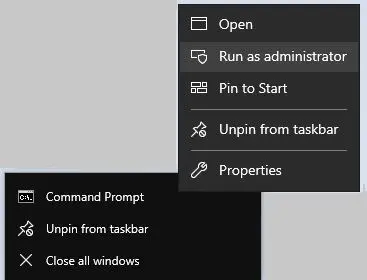
To register 64-bit DLL, please type in the following commands
                cd "C:\Program Files\Common Files\Barcodesoft\FontUtil"

                %systemroot%\System32\regsvr32.exe cruflbcs_x64.dll
1.2 Wenn Ihr SAP Crystal Reports 32-Bit ist, registrieren Sie bitte die 32-Bit-Version von cruflbcs.dll wie unten beschrieben.
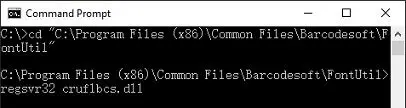
Type in the following commands to register 32-bit cruflbcs.dll
                cd "C:\Program Files (x86)\Common Files\Barcodesoft\FontUtil"

                regsvr32.exe cruflbcs.dll
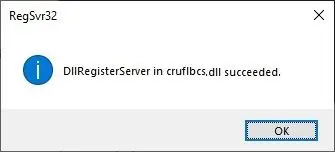
If you see the following Window pop up, your registration was successful.
2. Suchen Sie die UFL-Funktion.
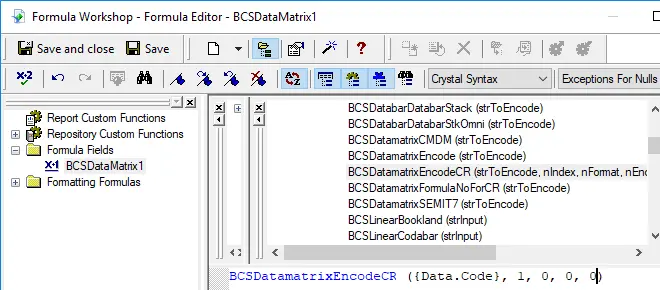
Navigieren Sie durch die Hierarchie: Funktionsliste ⇒ Zusätzliche Funktionen ⇒ COM- und .NET-UFLs (u212com.dll) ⇒ Visual-Basic-UFLs. Double-click on the BCSDataMatrixEncodeCR Funktion.
3. Erstellen Sie ein neues Formelfeld
Öffnen Sie Ihren Crystal Report. Right-click Formelfelder and choose "New..." from the context menu. Set the name to "BcsDataMatrix1", then click "Use Editor".

After Data Matrix encoding process, even a short string might have much more code words than you expect, while Crystal Reports allows no more than 255 characters in a formula field.
Therefore we have to split Data Matrix code words into separate parts, and concatenate them in a Text Object before apply font BcsDataMatrix.
As for how many formula fields are needed, you can find out by using the following function:
BCSDatamatrixFormulaNoForCR({Test.Data})
4. Erstellen Sie mehrere Formelfelder
Create multiple formula fields as listed below if returned value of BCSDatamatrixFormulaNoForCR({Test.Data}) is larger than one. Then put them in sequence within the same Text Object.
BCSDataMatrixEncodeCR({Test.Data}, 1, 0, 0, 0)
BCSDataMatrixEncodeCR({Test.Data}, 2, 0, 0, 0)
BCSDataMatrixEncodeCR({Test.Data}, 3, 0, 0, 0)
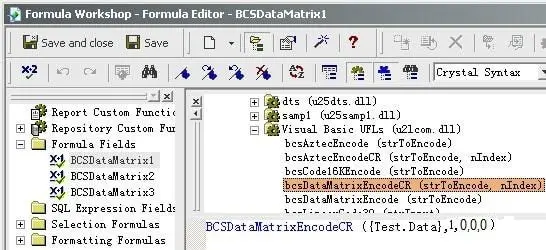
The first parameter in the formula field is string to encode.
The second parameter in the formula field is index.
The third parameter of the formula is Format. Its values range between 0 and 30. When set to zero, it means auto-selected format.
The fourth parameter is Encodation method. Its values range between 1 and 6 which stand for the following encodation separately: ASCII, C40, TEXT, X12, EDIFACT, BASE256.
The fifth parameter is GS1 indicator. It is a Boolean indicating whether this is a GS1-compliant barcode. Set it to zero when this is not GS1-datamatrix compliant.
5. Fügen Sie ein Textobjekt in Ihren Bericht ein.
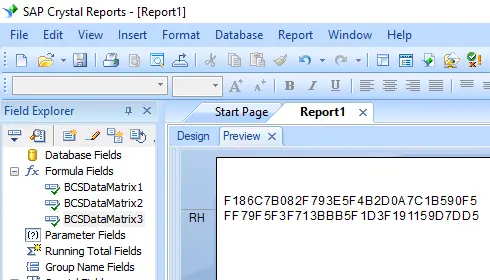
Drag and drop all your formula fields into this text object in sequence. You will see some hex codes in your report. Don't worry! You have NOT applied BCSDatamatrix font typeface yet.
6. Wenden Sie die Schriftart BcsDatamatrix an.
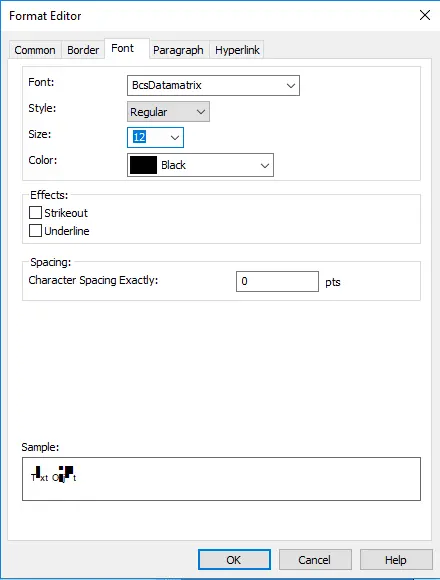
Rechtsklick Text Object and choose "Format Object" from context menu. Then choose "BcsDatamatrix" as font.
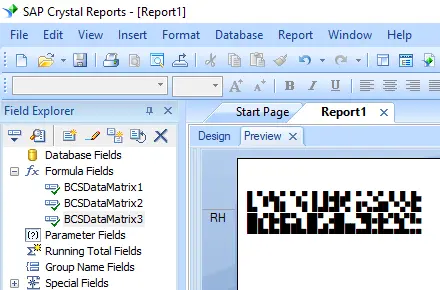
7. Datamatrix wird in Ihrem Crystal Reports erstellt.
Klicken Sie auf die Schaltfläche OK. You will get data matrix barcode in your report.